

Pay Attention
My first attempt at ekphrastic poetry - a poem responding to a work of art and the words of a poet!

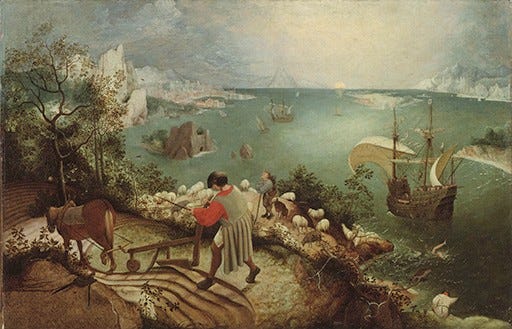
Pay Attention
“But for him it was not an important failure; the sun shone”

The important failure would be to allow suffering
to engulf him, to rip away his faith, to blind him of beauty –
the important failure would be to allow suffering
to rob him of tenderness, harden his heart,
to strip him of a soft belly, destroy his resistance,
to break his resolve, his back, his equanimity.

The important failure would be to allow suffering
to eclipse the sun, to vanquish the smell of spring.

No, not even the splash of green water – the boy drowning,
the bombs dropping near the horizon – caught his attention.
He steadied the plough,
prepared the ground – for another planting.

Later when he returned home, opened the window,
he listened to spring’s last whisper to day’s end.
He knew tomorrow,
she would be waiting – for him.


(First line in quotes from
Musée des Beaux Arts
by W. H. Auden.)
Auden referenced “an” important failure: one among many. You reference “the” important failure: which verges on implying singularity, or at least primacy.
Your lines circle around “generativity” (cultivation of fertile soil and an implication of human procreative power), along with the need to preserve hope and the ability to experience beauty and joy in the face of terror, destruction, lies, and desolation. And, of course, human survival into the future depends on cultivation and procreation. But what kind of future we have also depends on how we preserve not only empathy and nurturance, but the ideas elaborated and abstracted from those more primal impulses.
Still, on first reading, even if “he” opens the window after tending to future crops all day while firmly ignoring what he (presumably) could not control ( the immediacy of “the boy drowning” with that “splash of green water), I thought of “NOT SEES,” those who refuse to acknowledge the activities of those who seem self-destructively compelled to TRY to extinguish empathy and nurturance.
Who is Icarus? Is he merely a foolish boy who, in the exuberance of first flight, failed to heed (pay attention to) good paternal advice? Is he one who, inflated with lofty ideals, forgot to balance them with humility and self protective caution? Or is he one who identified powers with invincibility or even impunity?
More (most???) importantly… who are we as witnesses? To whom is our responsibility owed? When? And how? Auden referenced “an” important failure: one among many. You reference “the” important failure: which verges on implying singularity, or at least primacy.
Your lines circle around “generativity” (cultivation of fertile soil and an implication of human procreative power), along with the need to preserve hope and the ability to experience beauty and joy in the face of terror, destruction, lies, and desolation. And, of course, human survival into the future depends on cultivation and procreation. But what kind of future we have also depends on how we preserve not only empathy and nurturance, but the ideas elaborated and abstracted from those more primal impulses.
Still, on first reading, even if “he” opens the window after tending to future crops all day while firmly ignoring what he (presumably) could not control (the immediacy of “the boy drowning” with that “splash of green water”), I thought of “NOT SEES,” those who refuse to acknowledge the activities of those who seem self-destructively compelled to TRY to extinguish empathy and nurturance.
Who is Icarus? Is he merely a foolish boy who, in the exuberance of first flight, failed to heed (pay attention to) good paternal advice? Is he one who, inflated with lofty ideals, forgot to balance them with humility and self-protective caution? Or is he one who identified powers with invincibility or even impunity?
More (most???) importantly… who are we as witnesses? To whom is our responsibility owed? When? And how?
"The important failure would be to allow suffering
to eclipse the sun, to vanquish the smell of spring." Thank you for the deep wisdom of your beautiful lines, Karen. 🙏🏻